
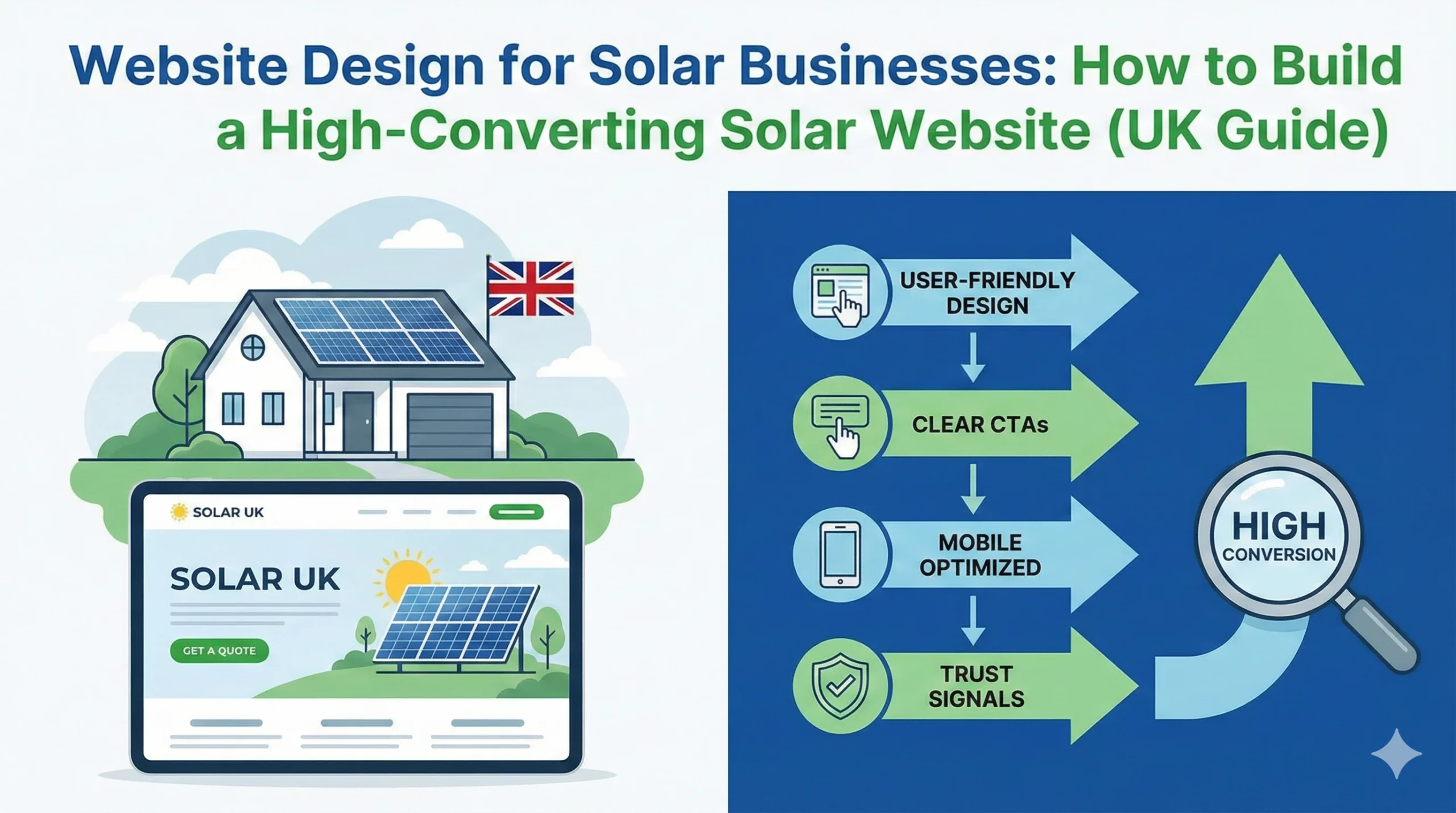
A solar company’s website isn’t just a brochure — it’s a lead generation engine.
In today’s UK solar market, homeowners compare multiple installers before deciding who to trust.
Your website must prove credibility, explain savings clearly, and guide visitors to book a free survey or request a quote.
Here’s a complete guide to designing a professional, modern, and high-converting solar website that brings in more enquiries, more booked surveys, and more installations.
1. Start With a Clean, Simple, Modern Design
Homeowners feel more confident when your website looks clean and trustworthy.
Your homepage should show:
- A bold headline
- Clear benefits
- A strong CTA (Free Solar Survey / Get a Quote)
- Real installation photos
- Trust badges (MCS, HIES, TrustMark)
- Google reviews
Avoid clutter. Simplicity = credibility.
2. Make Your Hero Section Do 80% of the Work
Homeowners decide in 3–5 seconds whether to trust you.
Strong hero example:
“Save Up to 70% on Energy Bills With Solar + Battery Storage”
Free Solar Survey • MCS Certified Installer • 10+ Year Warranty
Add two clear CTA buttons:
- Book Free Survey
- Get a Quote
This instantly drives conversions.
3. Show Trust Immediately (Huge for Solar Installers)
Solar is expensive — homeowners want reassurance.
Include:
✔ MCS certification
✔ HIES membership
✔ TrustMark logo
✔ Google & Trustpilot ratings
✔ “Installed 500+ systems across the UK”
✔ Real customer photos
Trust signals can increase lead conversion by 30–40%.
4. Use Real Photos, Not Stock Images
Solar customers want proof you’re a real installer.
Show:
- Roof installations
- Battery storage setups
- Inverter installations
- Team photos
- Customer handover photos
- Before/after savings examples
Authenticity = trust → more leads.
5. Explain Solar Savings in Simple Language
Don’t overwhelm visitors with technical jargon.
Explain benefits in plain English:
✔ Save up to £1,200/year
✔ Reduce reliance on the grid
✔ Protect against rising energy prices
✔ Add value to your home
✔ Government incentives (0% VAT)
Use icons and short bullet points to keep it scannable.
6. Highlight the Installation Process (4 Simple Steps)
Make the process feel easy.
Example:
- Book a Free Survey
- Get a Full Roof Assessment + Savings Report
- Choose Your Solar Package
- Installation in 7–14 days
Customers take action when they understand the journey clearly.
7. Build High-Converting Service Pages
Each service needs its own targeted page:
Must-have pages:
- Solar Panel Installation
- Battery Storage Installation
- Solar + Battery Packages
- Inverter Replacement
- EV Charger Installation (optional upsell)
- Commercial Solar (optional)
Each page should have:
- Benefits
- Before/after photos
- FAQs
- Strong CTA buttons
This helps SEO and increases inquiries.
8. Add a Multi-Step Quote Form (Boosts Conversions)
Forms are the MOST important part of your solar website.
Multi-step forms convert much better because they feel simpler and more engaging.
Include fields like:
- Are you the homeowner?
- Postcode
- Property type
- Interest: Solar only / Solar + Battery / Battery only
- Contact details
Smart qualification improves lead quality and saves time.
9. Include a Solar Savings Calculator or “Check Your Roof” Tool
Interactive tools significantly increase lead volume.
Options:
- Solar savings calculator
- Roof suitability checker
- Instant estimation form
- Battery ROI calculator
These features boost engagement and motivate people to convert.
10. Make It Easy to Contact You
Place phone numbers and CTAs everywhere:
- Sticky header with “Book Free Survey”
- Click-to-call button on mobile
- WhatsApp chat button
- Contact form in the footer
- Location pages for local SEO
Every extra contact point = more enquiries.
11. Add Local SEO Pages to Rank in Towns You Serve
If you install in multiple towns, you MUST have location pages such as:
- Solar Installers in Milton Keynes
- Solar Panels in Reading
- Solar Installers in Manchester
- Battery Storage Installers in Surrey
- Solar Panels Bristol
These pages rank extremely well for local searches → free leads.
12. Add an Education Section (Blogs + Guides)
Solar is a research-heavy purchase.
Educational content builds authority.
Blog topics:
- Solar panels cost UK
- Solar + battery ROI
- What is MCS certification?
- How much can I save with solar?
- Best solar panels to choose in 2025
Helpful content = trust + free Google traffic.
13. Build a Fast, Mobile-Friendly Website
Most solar leads come from mobile.
Your site must be:
✔ Fast loading
✔ Easy to scroll
✔ Button-friendly
✔ Clean and minimal
A slow website kills solar conversions.
14. Add Retargeting Pixels (Essential for Solar)
70% of visitors don’t convert on the first visit.
Retarget them with:
- Facebook ads
- Instagram ads
- YouTube ads
- Google Display ads
Message example:
“Still thinking about solar? Check if your roof qualifies.”
Retargeting improves conversions by 10–20%.
15. Show Real Testimonials + Case Studies
Solar customers love seeing:
- Real savings
- Before/after bills
- Customer photos
- Neighbourhood projects
- Battery installation success stories
Social proof is the strongest conversion element.
How 5xBusiness Helps Solar Installers Build High-Converting Websites
Position your agency here:
5xBusiness builds solar websites that:
- Convert visitors into booked surveys
- Increase leads by 2–5x
- Improve trust and credibility
- Rank for local solar searches
- Integrate with Google Ads + Performance Max
- Include smart form qualification
- Load fast on mobile
- Track every lead and call
We specialise in solar lead generation — not generic websites.
A high-converting solar website + proper ads = predictable growth.