
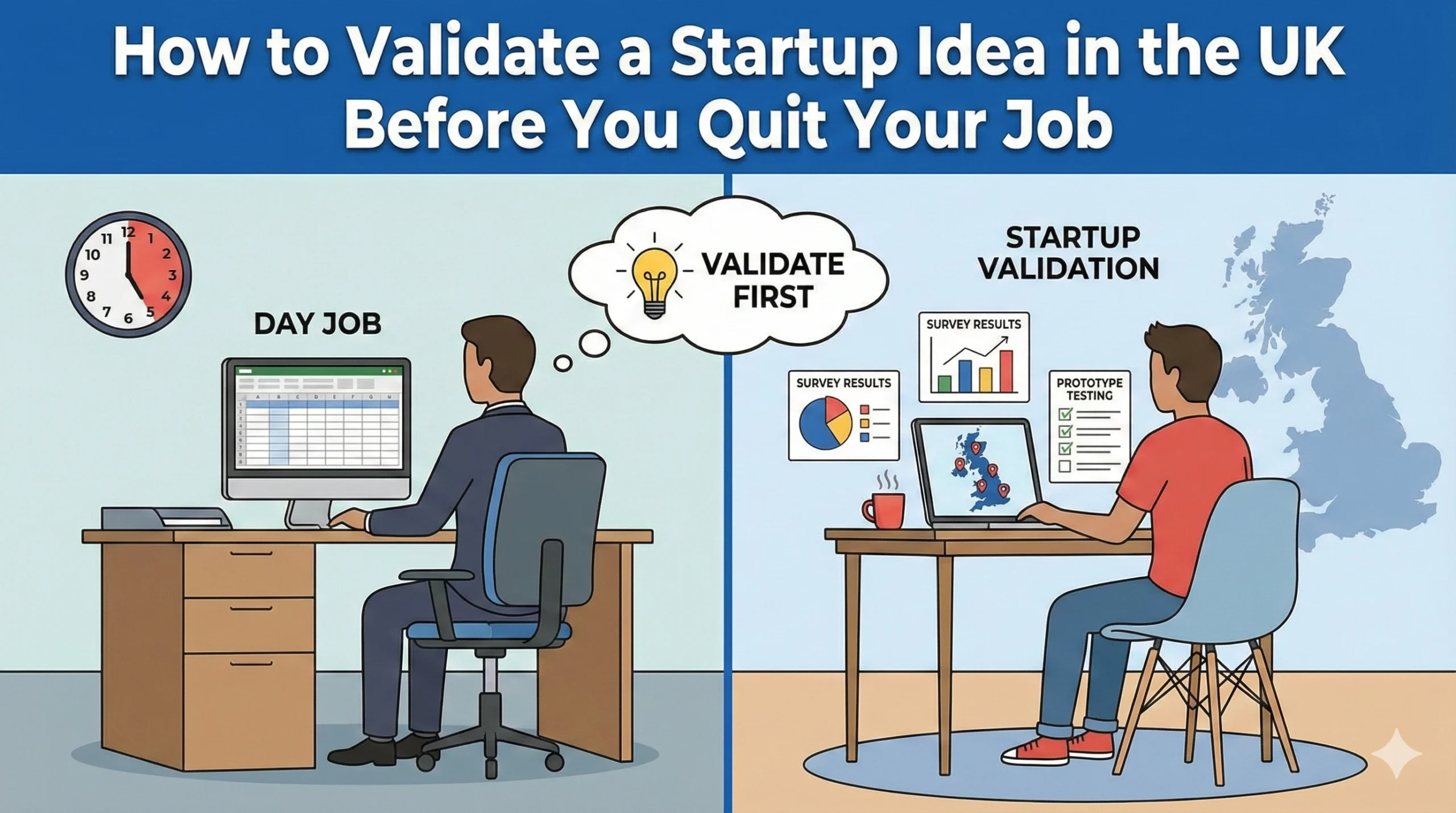
One of the biggest reasons UK startups fail isn’t funding.
It isn’t the economy.
It isn’t competition.
It’s building something the market simply doesn’t want.
It’s heartbreaking, but we see it often:
A founder spends months (or years) perfecting a product, branding, website, packaging — only to realise that the UK market wasn’t willing to pay for it in the first place.
The good news?
You can avoid 90% of the risk by validating the idea early — long before you quit your job or commit big money.
This guide breaks down exactly how UK founders can validate an idea the right way — using real UK tools, local research, and practical steps that won’t cost you much.
1. Start With the UK Problem, Not the Product
Founders often fall in love with their idea instead of the problem.
But problems — not products — create demand.
Start by asking:
- What problem do people in the UK actually complain about?
- What do they struggle with daily?
- What are they already trying to solve manually?
- What costs them time, money, or sanity?
Where do you find real UK problems?
- Facebook Groups (local communities, trades, coaching, parenting, SMEs)
- Reddit UK subreddits
- TikTok comments
- Trustpilot complaints
- Google Reviews
- Quora UK
- LinkedIn discussions
This gives you real-life, unfiltered complaints — the best starting point for validation.
2. Check If People Are Already Searching for It (UK Search Volume)
Before you build anything, see if people in the UK are actively looking for solutions.
Use tools like:
✔ Google Trends UK
✔ SEMrush (UK database)
✔ Ahrefs (UK region)
✔ UberSuggest UK
✔ AnswerThePublic (UK)
Look for:
- Rising search terms
- Consistent demand
- Problem-based searches
For example:
If searches like “gym leads uk” or “how to fix misted windows london” are trending — that’s validation.
If your idea has near-zero search interest — big red flag.
3. Do a Quick UK Competitor Scan
Contrary to belief, having competitors is GOOD.
It means there’s demand.
Look for:
- Existing UK businesses solving a similar problem
- Their pricing
- Their reviews
- Their weaknesses
- Their customer complaints
- Who they target
A simple competitor scan:
- Search Google: “<your idea> UK”
- Check the top 10 websites
- Look at their GBP profiles
- Read their reviews
- Identify complaints (goldmine)
- Write down gaps in service
These gaps are often where your startup can win.
4. Talk to Real People (10–20 UK Conversations Is Enough)
This is the most underrated validation step.
Reach out to people who match your ideal audience.
Ask them:
- “What’s the biggest frustration you have with X?”
- “How do you currently solve it?”
- “What have you tried that didn’t work?”
- “What would an ideal solution look like?”
- “If I built something that solved this properly, would you pay for it?”
Important:
Don’t pitch. Just listen.
A founder in Bristol validated her entire coaching business after 12 conversations — before creating anything.
5. Build the Smallest Possible Version (MVP) — Without Coding or Spending Much
Your MVP should NOT be:
- an app
- a full website
- a product line
- a software build
- a fancy brand
Your MVP should be the simplest version that tests whether people will pay.
Examples:
- A Google Form
- A landing page with a “join waiting list” button
- A manual service delivered through email
- A Figma prototype
- A Notion dashboard
- A simple Shopify or WooCommerce page
- A WhatsApp chatbot
- A beta offer with you delivering things manually
One UK founder tested an entire SaaS idea by using Google Sheets for 6 weeks — and only built the software once he had 50 paying users.
6. Collect Real UK Feedback (Not from Friends & Family)
Your friends and family will lie unintentionally.
They want to support you.
They’ll say:
- “This is brilliant!”
- “You should do it!”
- “People will love this!”
None of this is useful.
You need UK strangers to validate:
- Social media groups
- Cold outreach
- Micro-influencers
- Facebook page testing
- Simple Meta Ads (£10/day)
The feedback from strangers is the truth.
7. Try Selling It Before It’s Fully Built (Real Validation)
This step scares founders, but it removes 95% of the risk.
Create a simple landing page with:
- A clear problem
- Your solution
- A price (even if discounted)
- A sign-up or pre-order option
- Payment or deposit button
- A deadline
- Benefits + social proof
- Guarantee or risk-free trial
If people actually pay or register, your idea is validated.
If no one signs up — you saved months.
A UK fitness tech founder validated his idea by pre-selling access to a programme for £49 — before creating anything.
He sold 22 spots in 3 days.
That’s validation.
8. Run a Small UK Ads Test (Optional but Powerful)
You don’t need big budgets.
Even £50–£150 in ads can tell you:
- If people click
- If they’re interested
- What messaging works
- Whether the idea has legs
Best ads for early validation:
- Meta Ads (cheapest CPM in the UK)
- TikTok Ads
- Google Ads (if problem-based search exists)
A London-based SaaS founder used £72 of ad spend to validate a B2B product and gained his first 14 beta users.
9. Check Unit Economics (Does It Make Sense Financially?)
Even if people want your idea, it must make financial sense.
Calculate:
- Cost to acquire one customer
- Cost of delivering the service/product
- Profit per customer
- Repeat purchase potential
- Lifetime value
- Churn risk
- Scalability
If the economics don’t make sense now, they won’t magically fix later.
10. Build a Waiting List of Interested UK Customers
This is your strongest validation.
Aim for:
✔ 100+ warm leads
✔ 20–50 beta testers
✔ At least 10 people willing to pay a discounted pre-launch price
A waiting list gives you:
- Proof
- Confidence
- Feedback
- Early revenue
- A community
- A launch audience
5xBusiness helps founders build pre-launch funnels that attract UK leads before launch — especially useful when budgets are tight.
Final Thoughts: Don’t Quit Your Job Until the UK Market Confirms Your Idea
As romantic as it sounds to “take the leap”, the smartest UK founders don’t leap blindly.
They validate quietly.
They build slowly.
They test the waters.
They collect data.
They prove the demand.
They get their first customers.
They stabilise income.
Then they quit — with confidence, not hope.
Validation isn’t a luxury — it’s a safety net.
This is exactly where 5xBusiness helps founders:
- Pre-launch funnels
- MVP landing pages
- Ads testing
- UK market research
- Competitor analysis
- Offer development
- Website building
- CRM setup
- Content strategy
- Affordable support (far cheaper than typical UK agencies)
If you’re serious about validating your idea properly — without burning through money — we can help you test and grow with complete clarity.